
Inscript Keyboard Layout for Hindi Typing
The Government of India standard layout for Hindi and other Indic scripts - what it is and how to prepare.
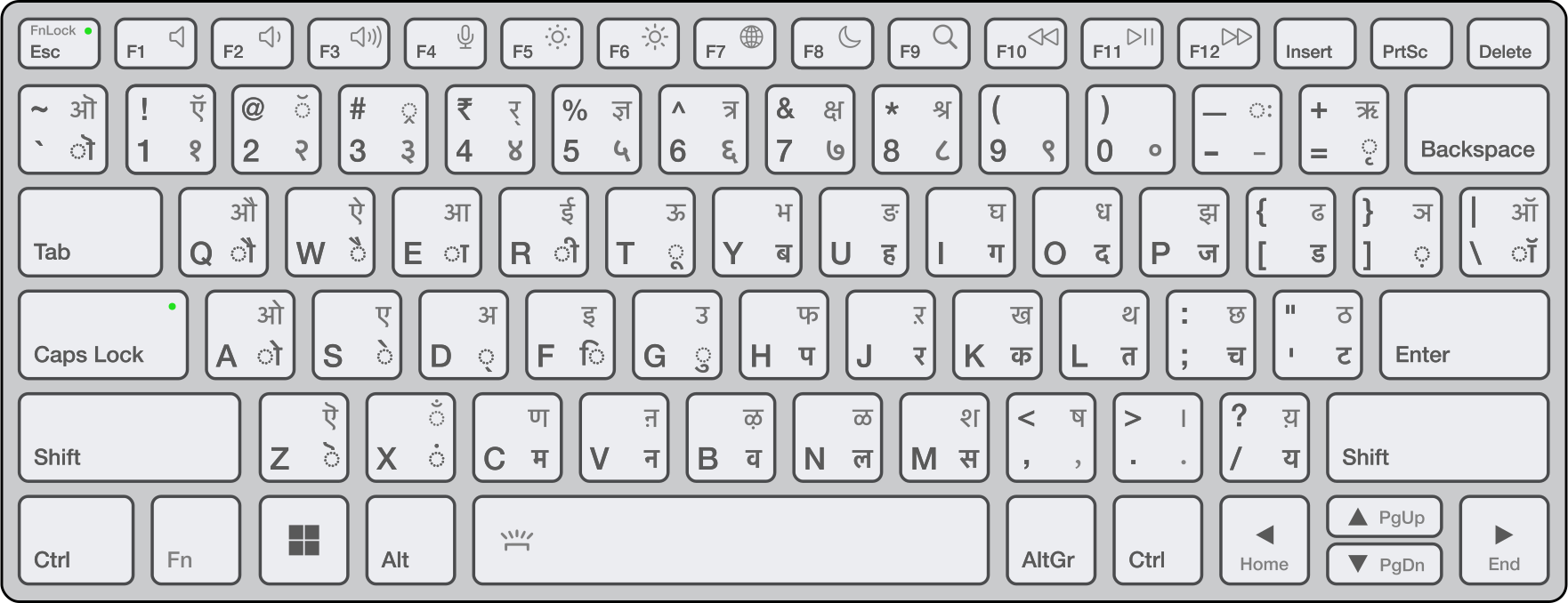
Inscript was developed as part of ISCII (Indian Script Code for Information Interchange), an effort to standardize how Indic scripts are encoded and typed across computing systems. Unlike typewriter-derived layouts, Inscript was designed from the alphabet outward: vowels are grouped together on one side of the keyboard, consonants on the other, and the arrangement follows the traditional order of the Devanagari varnamala (vowel and consonant sequence) as closely as a fixed keyboard allows.
Who requires Inscript
Inscript is commonly listed as an accepted layout for government Hindi typing exams - often alongside Remington Gail as an alternative - and for typing exams in other Indian languages it is frequently the default or only standardized option, since ISCII was designed to cover multiple scripts. As with any layout requirement, check your specific exam's official notification, since different recruiting bodies and posts specify different accepted layouts and required speeds.
Why the same layout works across languages
Because Inscript maps keys to phonetic categories rather than specific Hindi letters, the same finger positions produce the corresponding sounds in other Indic scripts typed with their own Inscript variants - Bengali, Tamil, Telugu, Malayalam, Gujarati, Marathi, Punjabi, and more. This is genuinely useful if you expect to type in more than one Indian language over your career: the muscle memory largely transfers, unlike moving between different typewriter-derived layouts for each language.
How to prepare
- Practice with typing tutor software or an operating system Inscript keyboard configuration, rather than trying to memorize a static picture of the layout.
- Learn vowels and common consonants first, then build up to matras (vowel signs) and conjuncts, mirroring how Inscript groups them logically.
- Prioritize accuracy early - most exams calculate net WPM by deducting for errors, so clean, correct typing at a moderate pace scores better than fast, error-prone typing.
- Practice on full paragraphs close to your exam's style and length, not just isolated words or letters.
Whichever layout you end up typing on for your exam, the underlying skills of accuracy and sustained speed transfer between layouts. Our Hindi Typing Speed Test lets you measure your WPM and accuracy on exam-style Hindi passages so you can track real progress.